When a major disaster strikes, when a large-scale security operation is deployed, or when a complex rescue mission unfolds across a wide area, one critical need emerges almost immediately. Decision makers, field commanders, and coordination teams need a central point from which to think, communicate, and direct everything happening around them. In a dynamic and unpredictable environment, that central point cannot be a fixed building. It has to move. It has to be wherever the operation demands it to be.
This is the purpose of a Mobile Command Center.
By Cardiff Engineering Services | Special Purpose Vehicles & Custom Fabrication
What Is a Mobile Command Center?
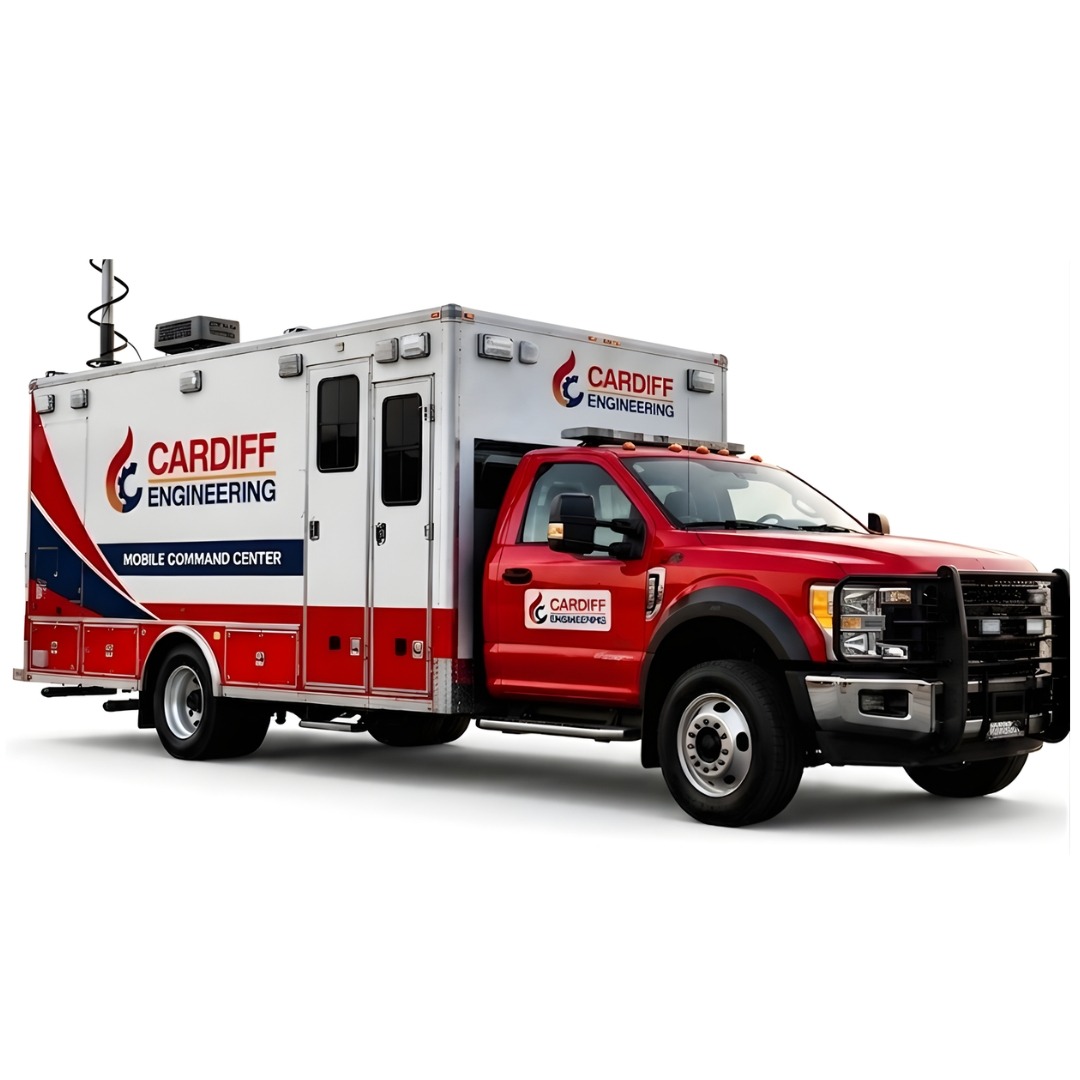
A Mobile Command Center, also referred to as a Mobile Command Post or Incident Command Vehicle, is a purpose-built vehicle that serves as a fully operational headquarters in the field. It brings together communication systems, situation awareness tools, decision-making space, and coordination infrastructure into a single deployable unit that can be positioned at or near any incident regardless of location.
Unlike a standard office or a temporary tent setup, a Mobile Command Center is self-sufficient. It operates independently of local power infrastructure, maintains secure and redundant communications in environments where networks are disrupted, and provides a professional working environment for commanders and coordination teams under conditions that are anything but normal.
The vehicle does not fight fires, treat patients, or rescue survivors. What it does is ensure that the people directing those who do have everything they need to make the right decisions quickly.
Who Uses Mobile Command Centers
The range of organizations that operate Mobile Command Centers is wider than most people expect.
Law enforcement and police agencies deploy them during large scale security operations, counterterrorism responses, and public order situations where real time situational awareness across multiple units is essential. Fire and rescue services use them at major incident scenes to coordinate multiple responding teams, manage resource allocation, and liaise with hospitals and civil authorities. Disaster management authorities including NDMA and provincial DMAs position Mobile Command Centers at the heart of flood, earthquake, and industrial disaster responses where multiple agencies must work together under a single coordinated framework. Military and paramilitary forces use them for field operations requiring a forward headquarters with secure communication capability. Large corporations operating critical infrastructure including power plants, airports, and seaports maintain Mobile Command Centers as part of their business continuity and emergency preparedness planning. Event security organizations managing major public gatherings rely on them to maintain oversight of thousands of people across large venues.
In every case the common requirement is identical. Real-time information, reliable communication, adequate working space, and the ability to be anywhere the situation demands.
Why a Mobile Command Center Changes the Outcome of an Emergency
Emergency management research consistently identifies poor communication and fragmented coordination as leading factors in avoidable losses during major incidents. When commanders cannot communicate clearly with field teams, when agencies cannot share information with each other in real time, and when decision makers are operating from incomplete or delayed situational awareness, the consequences are measured in lives, infrastructure, and time.
A properly equipped Mobile Command Center directly addresses every one of these failure points. It puts the right people in the same space with the right tools and connectivity at the right location. It eliminates the delays and distortions that occur when coordination is attempted across multiple separated locations using standard communication channels.
Pakistan’s disaster management experience over recent decades, from the 2005 earthquake to the 2010 and 2022 floods to recurring urban emergencies, has repeatedly demonstrated how coordination gaps multiply the impact of an already severe situation. Investment in Mobile Command Center capability is one of the most direct ways an organization or authority can close those gaps.
Core Capabilities of a Modern Mobile Command Center
While every Mobile Command Center is configured to the specific needs of the organization operating it, the most effective units share a set of essential capabilities.
Robust communication infrastructure is the foundation of everything. This includes VHF and UHF radio systems, satellite communication for areas where terrestrial networks are down or congested, secure telephone lines, and in modern deployments cellular network boosters that extend coverage in areas of weak signal. Without reliable communication a command vehicle is simply a meeting room on wheels.
Situation display and mapping systems allow commanders to maintain a real-time picture of the operational environment. Digital mapping, incident tracking software, and display screens that can show feeds from multiple sources simultaneously are standard in well equipped units.
Working space designed for decision making under pressure is another critical element. Enough room for a command team to work without being cramped, with proper seating, surfaces, lighting, and climate control that keeps people functional during extended operations in extreme weather conditions.
Power independence through an onboard generator or battery system ensures the vehicle remains fully operational regardless of what is happening to the local power grid. And storage for maps, communication equipment, documentation, and personal protective equipment ensures the vehicle is genuinely self-sufficient from the moment it deploys.
Mobile Command Centers in Pakistan’s Security and Disaster Landscape
Pakistan operates in one of the most complex security and disaster risk environments in the world. The country faces natural disaster risks including seismic activity, monsoon flooding, and extreme heat events alongside ongoing security challenges that require coordinated multi-agency responses at short notice.
Despite this reality, Mobile Command Center capability remains underdeveloped across many of Pakistan’s provincial emergency management structures, municipal authorities, and large industrial operators. The gap between what is needed and what is currently available represents both a serious risk and a significant opportunity for organizations willing to invest in proper preparedness infrastructure.
NDMA, provincial rescue services such as Rescue 1122, and large infrastructure operators are among the organizations that have recognized this gap and are actively developing Mobile Command Center capability as part of broader emergency preparedness upgrades.
Making the Right Investment
A Mobile Command Center is a long term infrastructure investment. The vehicle that is properly specified, well built, and correctly equipped will serve an organization effectively for well over a decade. Getting the specification right from the start matching the vehicle’s capabilities to the organization’s actual operational requirements, communication systems, and deployment environment is what determines whether the investment delivers real operational value or simply satisfies a procurement requirement on paper.
Cardiff Engineering Services works with emergency management planners, security agencies, and facility operators to develop Mobile Command Center solutions that fit the real demands of their operating environment.