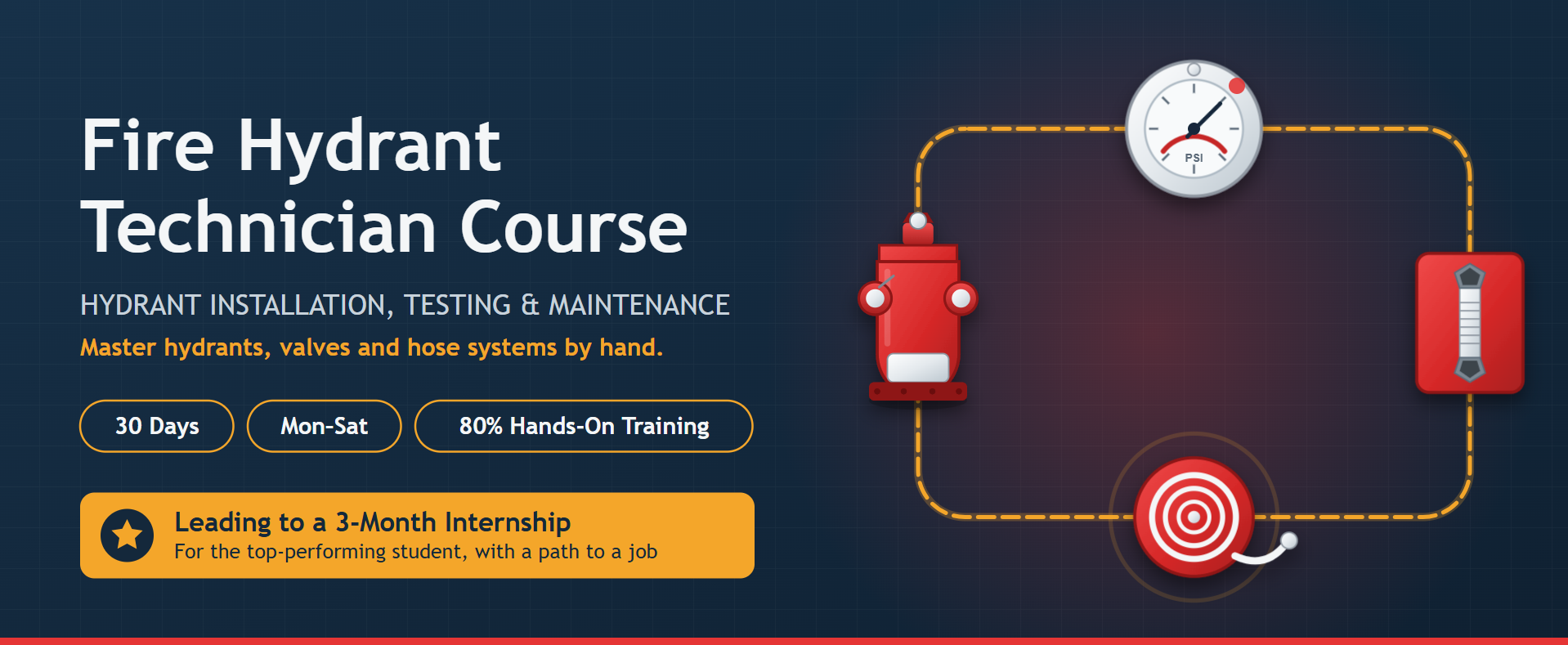
Fire Hydrant Technician Course

Course Fee

Contact for pricing

Fee and next batch dates shared on request.

30 Days

Mon–Sat

Beginner+

Yes

80% Practical

This course includes:

30 Days

Classroom + practical

80% Practical

Hands-on training

4 Weeks

10 Modules

Certificate

+ internship opportunity

Overview

Learn how hydrant systems keep buildings safe

This course develops practical technical skills for installing, inspecting, testing, operating and maintaining fire hydrant and water-based fire protection systems — covering hydrant components, fire pumps, water storage tanks, valves, piping, hose reels, landing valves, fire hoses, nozzles, pressure testing, flow testing and system troubleshooting. You'll learn how these components work together to provide an effective water supply during a fire emergency, alongside relevant fire protection practices and safe working procedures.

Water supply fundamentals

Fire water tanks, suction arrangements and supply reliability.

Fire pump systems

Electric, diesel and jockey pumps, controllers and alarms.

Pressure & flow testing

Hands-on hydrant pressure and flow testing procedures.

Course objectives

What this course sets out to teach

Participants learn how to identify hydrant system components, understand system layouts, carry out basic installation work, inspect equipment, perform testing procedures, and identify common operational faults. The course focuses on skills that technicians can apply during installation, maintenance, and inspection work.

Entry requirements

Who can join?

The course suits learners with basic technical knowledge. Recommended backgrounds include FCS, ICS / Intermediate, a technical diploma or DAE, Electrical, MEP, fire safety or maintenance work.

Course structure

What this course sets out to teach

Participants learn how to identify hydrant system components, understand system layouts, carry out basic installation work, inspect equipment, perform testing procedures, and identify common operational faults. The course focuses on skills that technicians can apply during installation, maintenance, and inspection work.

  • Module 1 — Introduction to Fire Protection Systems

    • Fundamentals of fire protection
    • Fire triangle and fire behavior
    • Classes of fire
    • Active and passive fire protection
    • Water-based fire protection systems
    • Role of fixed firefighting systems
    • Introduction to hydrant systems
    • Applications of hydrant systems
    • Commercial and industrial applications
    • Basic fire safety terminology
  • Module 2 — Fire Hydrant System Components

    • Fire hydrants
    • Hydrant valves
    • Landing valves
    • Hose reels
    • Fire hoses
    • Branch pipes
    • Nozzles
    • Hose couplings
    • Fire department connections
    • Isolation valves
    • Check valves
    • Pressure gauges
    • Flow switches
    • Drain valves
    • Test connections
  • Module 3 — Hydrant Piping Systems

    • Fire water piping fundamentals
    • Above-ground & underground piping
    • Pipe sizes and fittings
    • Pipe supports
    • Flanges and threaded connections
    • Grooved pipe connections
    • Elbows, tees and reducers
    • Valve arrangements
    • Basic piping drawings
    • Reading hydrant system layouts
  • Module 4 — Fire Water Storage & Supply

    • Purpose of fire water storage
    • Fire water tanks
    • Tank connections
    • Suction arrangements
    • Tank level monitoring
    • Water supply requirements
    • Gravity and pumped supply
    • Fire pump suction
    • Water supply reliability
    • Basic water-flow concepts
  • Module 5 — Fire Pump Systems

    • Fire pump fundamentals
    • Centrifugal fire pumps
    • Electric fire pumps
    • Diesel fire pumps
    • Jockey pumps
    • Pump controllers
    • Suction and discharge arrangements
    • Pressure gauges
    • Pump room components
    • Pump start/stop concepts
    • Pump alarms
    • Common pump problems
  • Module 6 — Fire Hydrant System Installation

    • Site preparation
    • Hydrant location considerations
    • Piping route planning
    • Pipe installation sequence
    • Valve installation
    • Hydrant installation
    • Landing valve installation
    • Hose reel installation
    • Fire hose connection
    • Nozzle installation
    • Fire department connection
    • Supports and brackets
    • Pipe identification
    • Installation quality checks
  • Module 7 — Hydrant System Testing

    • Visual inspection
    • Pressure testing
    • Flow testing
    • Hydrant flow testing
    • Pump testing
    • Valve testing
    • Hose inspection
    • Nozzle inspection
    • Leakage identification
    • Pressure gauge verification
    • System flushing
    • Test documentation
  • Module 8 — Hydrant System Maintenance

    • Preventive maintenance
    • Routine inspections
    • Valve maintenance
    • Hydrant maintenance
    • Hose maintenance
    • Nozzle maintenance
    • Pump maintenance basics
    • Tank inspection
    • Pressure gauge inspection
    • Corrosion identification
    • Leakage detection
    • Blockage identification
    • Maintenance documentation

  • Module 9 — Troubleshooting Fire Hydrant Systems

    • Low water pressure
    • Insufficient water flow
    • Pump not starting
    • Jockey pump running continuously
    • Valve leakage
    • Pipe leakage
    • Blocked piping
    • Damaged hose
    • Faulty nozzle
    • Pressure fluctuations
    • Pump vibration
    • Unusual pump noise
    • Tank water-level problems
    • Controller alarms
  • Module 10 — Fire Safety Standards & Documentation

    • Relevant fire protection standards & references
    • Basic inspection and testing documentation
    • Maintenance records and checklists
    • Safe work procedures
    • Basic reporting practices

Training pattern

Finish with a course completion certificate

Practical sessions allow participants to work with fire hydrant equipment and apply the techniques covered during the course. Activities may include component identification, inspection procedures, basic installation practices, testing, and fault identification.
FAQ

Frequently asked questions

What is a Fire Hydrant Technician Course?

It is technical training that teaches participants how fire hydrant systems work and how to perform basic installation, inspection, testing, maintenance and troubleshooting tasks.

Is the course mostly practical?

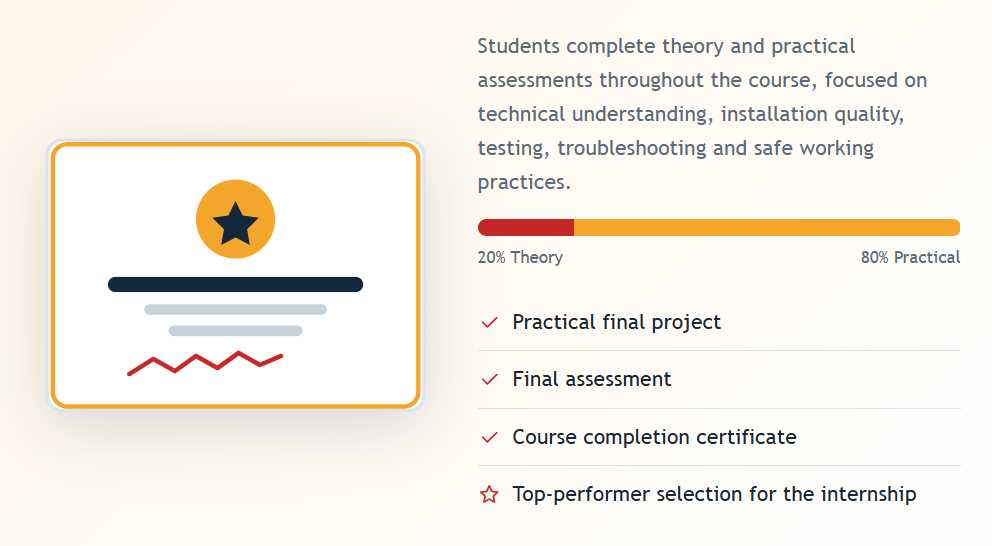
Yes. Training is 80% hands-on and 20% theory.

What will I learn in this course?

You will learn about hydrants, valves, fire hoses, nozzles, piping, water tanks, fire pumps, jockey pumps, testing, maintenance and troubleshooting.

Is the course practical?

Yes. The course is designed with a strong practical focus, including equipment demonstrations and hands-on technical exercises.

Will I receive a certificate?

Yes. Students who complete the training and assessments receive a course completion certificate.

How long is the course?

The proposed course structure is one month, with classes six days per week.

What career opportunities are available?

Depending on qualifications and experience, learners may pursue technician and support roles in fire protection, fire fighting systems, maintenance, MEP and facility management.

Does the course cover fire pumps?

Yes. It covers the fundamentals of electric, diesel and jockey pumps, pump-room components and basic troubleshooting.

Build Practical Fire Protection Skills

Join the Fire Hydrant Technician Course and develop practical skills in hydrant systems, fire pumps, installation, testing, maintenance and troubleshooting.
Perform well. Gain experience. Build your career.