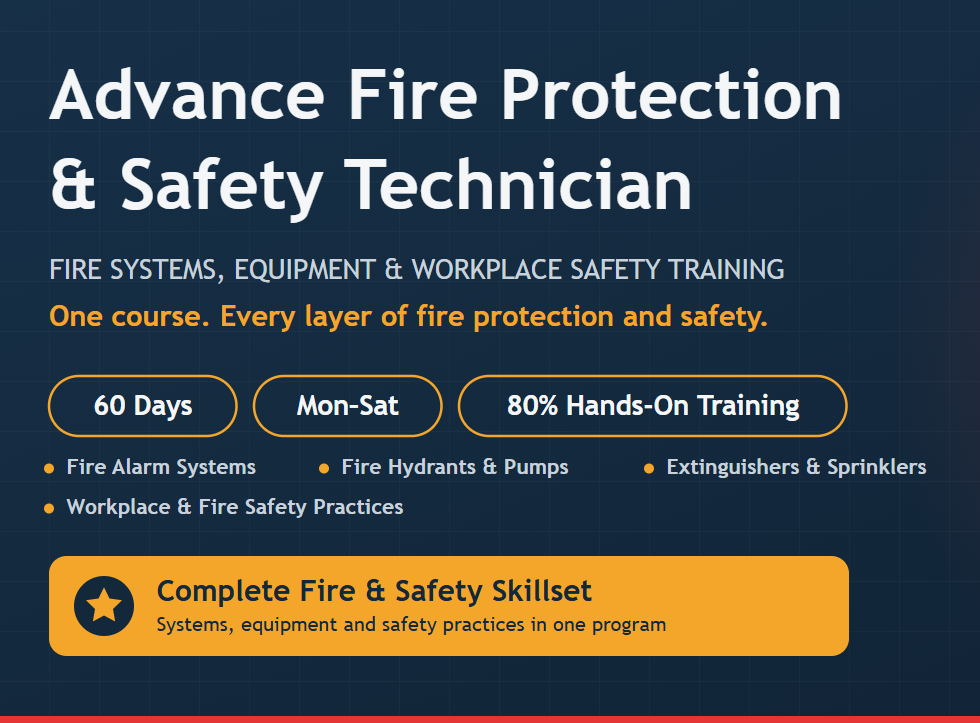
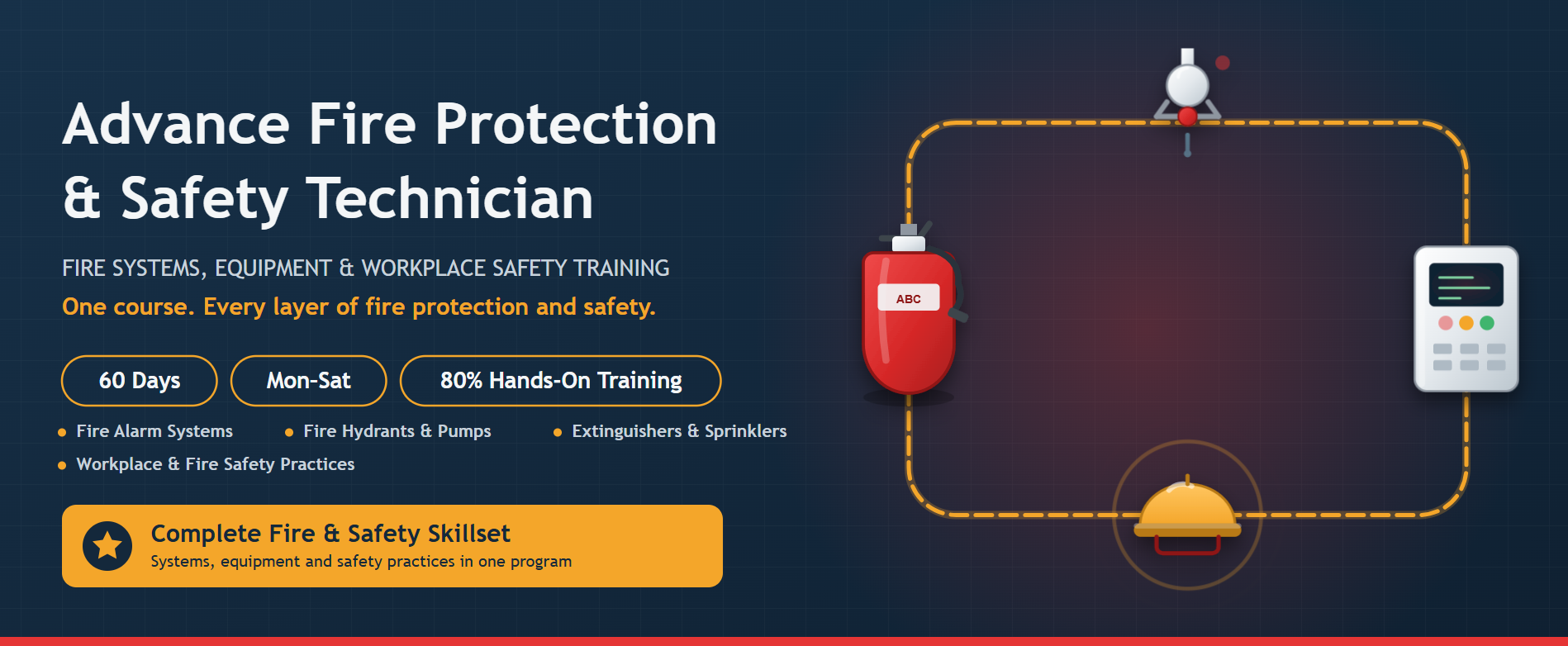
Advance Fire Protection and Safety Technician Course

Course Fee

Contact for pricing

Fee and next batch dates shared on request.

60 Days

Mon–Sat

Intermediate +

Yes

80% Practical

This course includes:

60 Days

Classroom + practical

80% Practical

Hands-on training

8 Weeks

10 Modules

Certificate

+ internship opportunity

Overview

Comprehensive Fire Protection & Safety Technician Training

This course combines two essential areas of fire protection training: Fire Alarm Systems and Fire Hydrant & Water-Based Fire Protection Systems. Students progressively learn how fire protection systems operate, how their components are installed, how systems are tested and commissioned, and how common faults are identified and resolved.

The program is designed around practical technical training so that students can develop hands-on understanding of fire alarm equipment, hydrant components, fire pumps, piping, valves, testing procedures, maintenance practices and technical documentation.

The two original programs provide the foundation for this combined structure: the Fire Alarm course focuses on installation, testing, commissioning, maintenance and troubleshooting, while the Hydrant course covers hydrant components, piping, fire pumps, installation, testing, maintenance and troubleshooting.

Fire alarm system skills

Conventional & addressable panels, detectors, wiring, testing, commissioning, basic programming and troubleshooting.

Fire hydrant system skills

Hydrants, valves, hose reels, piping, water tanks, fire pumps and water supply arrangements.

Installation, testing & maintenance

Practical exposure to installation, inspection, preventive maintenance, fault finding and documentation.

Course objectives

What this course sets out to teach

The Advanced Fire Protection & Safety Technician Course is designed to develop practical and technical skills for the installation, inspection, testing, maintenance, troubleshooting, and servicing of fire protection systems. This comprehensive 3-in-1 training covers fire alarm systems, fire hydrant systems, fire pumps, firefighting equipment, and fire safety practices, preparing learners for practical technical roles across commercial, industrial, construction, and facility management environments.


Entry requirements

Who can join?

The course suits learners with basic technical knowledge. Recommended backgrounds include FCS, ICS / Intermediate, a technical diploma or DAE, Electrical, MEP, fire safety or maintenance work.

Course structure

What this course sets out to teach

Five phases across ten weeks — from fire protection fundamentals, through fire alarm systems, into fire hydrant and water-based protection, fire pumps and hydrant installation, finishing with integrated testing, maintenance and troubleshooting.

  • Module 1 — Fire Protection Fundamentals

    Week 1

    • Fundamentals of fire protection
    • Fire triangle and fire behavior
    • Classes of fire
    • Active and passive fire protection
    • Water-based fire protection systems
    • Fixed firefighting systems
    • Basic fire safety terminology
    • Introduction to fire alarm systems
    • Introduction to fire hydrant systems
    • Fire protection applications
  • Module 2 — Fire Alarm Components & System Types

    Week 1

    • Conventional fire alarm systems
    • Addressable fire alarm systems
    • Fire alarm control panels
    • Smoke detectors
    • Heat detectors
    • Flame detectors
    • Gas detectors
    • Manual call points
    • Alarm sounders
    • Strobes
    • Input/output modules
    • Isolator modules
    • Fire alarm cables
    • Power supplies and batteries
  • Module 3 — Fire Alarm Installation

    Week 2

    • Fire alarm installation fundamentals
    • System layout understanding
    • Installation planning
    • Cable routing
    • Fire alarm wiring
    • Detector installation
    • Manual call point installation
    • Sounder installation
    • Module installation
    • Panel connections
    • Power supply connections
    • Battery connections
    • Basic system configuration
    • Installation quality checks
  • Module 4 — Fire Alarm System Testing

    Week 2

    • Fire alarm system testing
    • Device testing
    • Panel checks
    • Alarm testing
    • Fault indication
    • Loop checking
    • Device addressing
    • Basic panel programming
    • System commissioning
    • Testing documentation
  • Module 5 — Fire Alarm Inspection & Maintenance

    Week 3

    • Routine inspections
    • Preventive maintenance
    • Detector inspection
    • Panel inspection
    • Battery inspection
    • Wiring inspection
    • Device maintenance
    • System checks
    • Maintenance documentation
  • Module 6 — Fire Alarm Troubleshooting

    Week 3

    • Panel faults
    • Device faults
    • Wiring faults
    • Communication faults
    • Detector faults
    • Battery problems
    • False alarms
    • Addressing problems
    • Loop faults
    • Fault identification
    • Troubleshooting procedures
  • Module 7 — Fire Hydrant Components

    Week 4

    • Fire hydrants
    • Hydrant valves
    • Landing valves
    • Hose reels
    • Fire hoses
    • Branch pipes
    • Nozzles
    • Hose couplings
    • Fire department connections
    • Isolation valves
    • Check valves
    • Pressure gauges
    • Flow switches
    • Drain valves
    • Test connections
  • Module 8 — Fire Hydrant Piping Systems

    Week 4

    • Fire water piping fundamentals
    • Above-ground fire service piping
    • Underground fire service piping
    • Pipe sizes and fittings
    • Pipe supports
    • Flanges
    • Threaded connections
    • Grooved pipe connections
    • Elbows, tees and reducers
    • Valve arrangements
    • Basic piping drawings
    • Reading hydrant system layouts
  • Module 9 — Fire Water Storage & Supply

    Week 5

    • Fire water storage
    • Fire water tanks
    • Tank connections
    • Suction arrangements
    • Tank level monitoring
    • Water supply requirements
    • Gravity water supply
    • Pumped water supply
    • Fire pump suction
  • Module 10 — Fire Pump Fundamentals

    Week 5

    • Fire pump fundamentals
    • Centrifugal fire pumps
    • Electric fire pumps
    • Diesel fire pumps
    • Jockey pumps
    • Pump controllers
    • Suction arrangements
    • Discharge arrangements
    • Pressure gauges
    • Pump room components
    • Pump start/stop concepts
    • Pump alarms
    • Common pump problems
  • Module 11 — Hydrant Installation & Assembly

    Week 6

    • Site preparation
    • Hydrant location considerations
    • Piping route planning
    • Pipe installation sequence
    • Valve installation
    • Hydrant installation
    • Landing valve installation
    • Hose reel installation
    • Fire hose connection
    • Nozzle installation
    • Fire department connection
    • Supports and brackets
    • Pipe identification
    • Installation quality checks
  • Module 12 — Fire Hydrant System Testing

    Week 6

    • Visual inspection
    • Pressure testing
    • Flow testing
    • Hydrant flow testing
    • Pump testing
    • Valve testing
    • Hose inspection
    • Nozzle inspection
    • Leakage identification
    • Pressure gauge verification
    • System flushing
    • Test documentation
  • Module 13 — Fire Hydrant System Maintenance

    Week 7

    • Preventive maintenance
    • Routine inspections
    • Valve maintenance
    • Hydrant maintenance
    • Hose maintenance
    • Nozzle maintenance
    • Pump maintenance
    • Tank inspection
    • Pressure gauge inspection
    • Corrosion identification
    • Leakage detection
    • Blockage identification
    • Maintenance documentation
  • Module 14 — Fire Hydrant Troubleshooting

    Week 8

    • Low water pressure
    • Insufficient water flow
    • Pump not starting
    • Jockey pump running continuously
    • Valve leakage
    • Pipe leakage
    • Blocked piping
    • Damaged hose
    • Faulty nozzle
    • Pressure fluctuations
    • Pump vibration
    • Unusual pump noise
    • Tank water-level problems
    • Controller alarms
    • Incorrect valve position

Training pattern

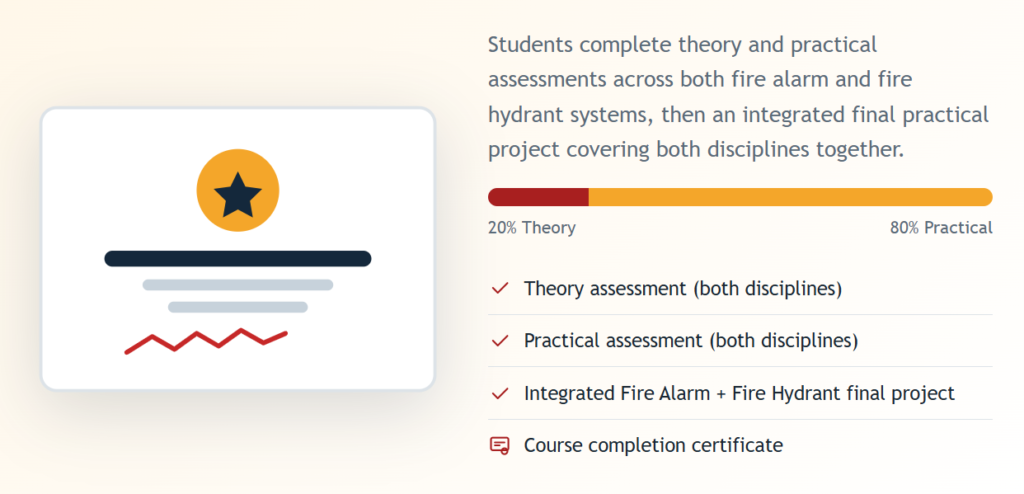
Finish with a course completion certificate

Practical sessions allow participants to work with fire hydrant equipment and apply the techniques covered during the course. Activities may include component identification, inspection procedures, basic installation practices, testing, and fault identification.
Outcomes

Career opportunities

This 3-in-1 Advanced Fire Protection & Safety Technician Course prepares learners with practical skills in fire alarm systems, fire hydrant systems, fire pumps, fire protection equipment, inspection, testing, maintenance, installation, and troubleshooting. After completing the course, learners can explore technical roles in fire protection, fire safety, building services, MEP, maintenance, and facility management, depending on their skills, qualifications, experience, and employer requirements.

FAQ

Frequently asked questions

What is the Advance Fire Protection & Safety Technician Course?

A 60-day professional training program covering fire alarm systems, fire hydrant systems, fire pumps, installation, testing, maintenance and troubleshooting.

How long is the course?

The program is structured for 60 days / 2 months, with classes conducted Monday through Saturday.

Is the course practical?

Yes. The program follows an 80% practical and 20% theory training approach.

What fire alarm systems are covered?

Conventional and addressable fire alarm systems, panels, detectors, modules, manual call points, sounders, wiring, testing, commissioning and troubleshooting.

Will I receive a certificate?

Yes. Students who complete the training and assessments receive a course completion certificate.

What career opportunities are available?

Depending on qualifications and experience, learners may pursue technician and support roles in fire protection, fire fighting systems, maintenance, MEP and facility management.

Does the course cover fire pumps?

Yes. It covers the fundamentals of electric, diesel and jockey pumps, pump-room components and basic troubleshooting.

Is there a final practical assessment?

Yes. Students complete theory and practical assessments along with an integrated final practical project.

Start Your Fire Protection Technician Career

Develop practical technical skills through a comprehensive program covering fire alarm installation, fire hydrant systems, fire pumps, testing, commissioning, maintenance and troubleshooting.
Learn → Practice → Test → Troubleshoot → Maintain → Get Certified